Sunday, March 24, 2013

Beyond Korea's Kimchi and Jjamppong

“Spontaneous”, the word that fully defined our “barkada” trip in Seoul. All I can remember was – without any itinerary on mind or in hand, we just packed our bags and bravely took a flight to a foreign land. Surprisingly though, for some of us who frequently travels, ideas were knitted spontaneously :|

Speaking of our college group’s Seoul travel, it was pretty much similar to our (not too long ago) thesis project, wherein deadlines force us to abruptly make reasonable decisions. I can’t say we weren’t successful, as we were able to visit countless historic places (even my feet can’t keep count, bcoz of sore and exhaust). As what we adventurous youngsters say: travels aren’t much fun without some added thrill! Let me share some of the thrill then, maybe it’d help you decide on booking your next trip to Korea :p -- we were chased by life- like zombies in a theme park; walked in circles.. after circles.. after circles (yeh! Admittedly, we got lost and no one there seemed to understand English), and of course, as with most tourist, we communicated via charades =D

(Tourist tip: Look for a person with a letter “i” on his hat- he could help you out with directions)

Though we had no itinerary on hand, we were fortunate enough to have tried some of Korea’s unique treats. By fortunate, I meant tasting Korean delicacies fit for a Filipino’s palette, of which my friends would whisper after every bite- “manamis-namis”


Savory Street BBQ

The very first street food I noticed was the “tender and juicy” looking Korean BBQ… By the looks of it, one couldn’t have guessed the type of meat coated under its thick brown sauce. Though, despite the uncertainty, we continuously devoured the grilled meat, picking a stick after another…  Good thing the stuff is made with white meat- Chicken!

School Food - Blooming Mari

This restaurant raves its deliciously cooked food, while authentically prepared the Korean way! 
The Beef Bokkeumbap is the Best! With rice cooked perfectly moist and fragrant…
As all fresh ingredients were mixed together, the plate itself was bursting with Asian flavors.

Street Vanilla Ice Cream

This particular Korean ice cream may not exactly taste extraordinary; yet, its distinctive shapes make it highly recommendable. I personally tried the “J” shaped cone, and true enough the shapes distinctiveness made it undeniably fun to eat. A plus: the cone remained crunchy till the last bite.

Tip: If travelling with a child, the J- shaped cone is truly a must try (While strolling, I saw a father carrying his child over his shoulders, and couldn't help but notice them sharing a J- shaped cone together, with the son eating the ice cream top- bottom while the father eating the same bottom- up.)

written by: Shobe

Thursday, March 21, 2013

Kitchen Basics - Your guide to 20 kitchen terms

Pasta - Al denteAl dente:  From the Italian phrase "to the tooth", it means cooking something such as pasta or vegetables until firm, not too hard and not too soft - left still slightly crisp.

Bain-marie: It is a term for hot water bath. A method used to ensure that food cooks evenly by immersing the container or pan in heated water.

Baste: A cooking technique for keeping meats and poultry moist while being cooked. It is to coat or brush food with sauce or its own juices.

Blanch: To quickly cook items in hot water and then plunge them into an ice water bath, which stops the cooking.This is often done to bring out color and preserve crispness.

Blind bake: To bake a pie crust or other pastry without the filling. To prevent puffing and slipping during baking, the pastry is lined with foil and filled with pie weights, dry beans, or uncooked rice. (I usually use dry beans.) These are removed shortly before the end of baking time to allow the crust to brown.

Brining: A process in which the meat is soaked in brine (or a salt solution) to ensure that it stays moist when cooked.

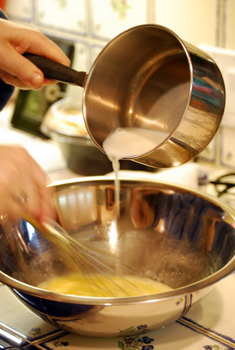
Curdling: Refers to the separation that occurs in egg or cream-based mixtures when they are heated to quickly.

Method: To cut inCut in: To mix butter or shortening into a dry ingredient (e.g. flour) using a fork, a pastry blender, or two knives. Though you can use your hands in a pinch, utensils are generally preferable as they will preserve the coldness of the fat, which affects the outcome of the final product.

Deglaze: To dissolve caramelized bits and food particles stuck on the bottom of a pan by adding liquid such as stock, wine, or even tomato sauce. Used to add more flavor to the dish or as a foundation for a sauce or gravy.

Emulsify: To combine two or more liquids that do not blend together easily, usually one that is fat and water based. For the liquids to combine properly, one is poured into the other while beating continuously.

Fold; Fold-in: To combine two ingredients or two combinations of ingredients by two motions; cutting vertically through the mixture and turning over and over by sliding the implement (usually a rubber spatula or wire whisk) across the bottom of the mixing bowl with each turn.

Ganache: A combination of chocolate and cream, melted together slowly. When used warm, ganache is poured over cakes or cookies to form a smooth glossy coating. Typically used as a sauce, frosting, or a glaze. If chilled, it can be formed into chocolate truffles.

Gratin: A culinary technique where the dish is topped with ingredients such as bread crumbs or grated cheese before being baked or broiled, creating a browned crust.

Julienne: To cut into thin strips or small, match-like pieces that are 1/8 of an inch wide and 1 to 2 inches long.

Poach: To simmer food in liquid (usually stock, though oil or even milk can be used) until it is cooked through. Eggs are usually associated with this cooking method, but anything from fish to fruit can be poached.

Reduce: Typically refers to the act of simmering or boiling liquid until it decreases, usually to achieve a thicker consistency or an intensified flavor.
Method: Tempering
Scald: Heating a liquid, usually milk, just below the boiling point.

Searing:  To brown food over high heat to lock in its juices. Food that is browned is usually braised or roasted to finish it off.

Simmer: A food preparation technique in which foods are cooked in hot liquids kept at or just below the boiling point of water.

Tempering: To temper means to gradually raise the temperature of an ingredient before adding it to a hot liquid, usually to prevent curdling.

Kitchen Basics - Tips on how to read a recipe correctly

FIVE STRATEGIES FOR RECIPE READING--AND COOKING SUCCESS!
  1. First, read the whole thing! Always carefully read through the entire recipe before preparing anything, so you aren't scrambling to retrieve the pepper mill from an overhead cabinet while your stir-fry comes dangerously close to burning. Remember: The order in which the ingredients are listed is usually the order in which they are used. Also, if a recipe says that a particular ingredient (for example, 1/2 cup olive oil) is "divided", that means that it won't be used all at once - so read the recipe and take note of when to add which amount.

  2. Take note of measurement notes. 1/4 cup melted butter" is different from "1/4 cup butter, melted". The former means that you melt enough butter to make 1/4 cup, measured in a liquid measuring cup. The latter, on the other hand, means that you simply take 1/4 cup butter in its solid state and melt it. The difference between the two is especially important to understand if you're baking, as the ingredients and instructions tend to be more precise in such recipes.

  3. Take note of measurement notes again. Just as "melted butter" and  "butter, melted" mean different things, "1/2 cup button mushrooms, sliced" and "1/2 cup sliced button mushroom" are not the same as well. If the manner in which the ingredient should be prepared comes after it (e.g., sliced), that usually means that you measure the ingredient (in this case, the mushrooms) before prepping them as instructed.

  4. Observe how food looks as it cooks. You'll often find instructions in recipes that tell you to cook something until it's translucent (onions), or fragrant (garlic), or brown (beef). Since every stove and pan is different, instructions that rely on your own senses are oftentimes more useful than telling you to cook something for a certain amount of time. This can be daunting for first-timers or novices, but don't be nervous: All it requires for you is to be present in the moment. Simply pay attention to what you're doing and you'll be fine.

  5. Polish your seasoning skills. Seasoning to taste means that you season the food as you go along, tasting it and adjusting as needed. Properly tasting the food is essential - how will you know if what you're making is good if you don't try it before serving it? It's better to add salt in increments, little by little, and then add more when required, for the simple reason that it's considerably easier to fix food that is under-seasoned than food that is overly salty.
Taken from Yummy 2011| by Liezl Yap

Foodnotes:
> If you are working in a fast paced kitchen environment, you could make your own recipe cheat sheet just to make sure you've taken note of everything (especially if there are slight changes with the recipe), and of course for convenience: (1) Use a 3" x 5" index card (2) Write the ingredients in order of which they are used in the left hand portion (3) Then, put a sequence number, and execution method per ingredient on the other side.

Tuesday, March 19, 2013

What you need for baking

A guide to the tools every home baker must have for a creative and stress-free time in the kitchen.

Silicone Oven Mitt
Silicone oven mitt
Heat-and slip-resistant, this mitt is also more durable than cloth potholders or oven mitts. It's easy to clean and comes in many fun colors!

Classic blender
Classic BlenderThis handy tabletop kitchen machine will take you from beverage to dessert to sauces and dips for main dishes. It's also handy for grinding cookies and nuts, for puréeing vegetables and fruits, and even for crushing ice.

Cream whipper
This tool produces instant topping for desserts, pastries, coffee, and other beverages. The metal siphon is fitted with a nitrous oxide cartridge that makes almost-instant whipped cream without the need for a mixer or a wire whisk. The canister also comes with decorative tips to make perfect rosettes.

Cream Whipper
Measuring cups and spoons
The cups come in sets of four or five, measuring 1 cup, 1/2 cup, 1/3 cup, and 1/4 cup. There are sets that include 1/8 cup. Spoons come in a set of five or six - 1 tablespoon, 1/2 tablespoon, 1 teaspoon, 1/2 teaspoon, 1/4 teaspoon and 1/8 teaspoon.

Pastry BrushPastry brush
Get one that is made with food-grade bristles. It is used for greasing pans, basting food that is being roasted or for glazing food.

Handheld blender
This small appliance, also called an immersion blender, can be put directly into a pot of vegetables ready to be puréed, can easily emulsify yogurt into a sauce, and whip cream in no time at all.

Handheld Blender
Kitchen tongs
For baked goods, tongs are good for lifting baked dinner rolls from the pan, for serving slices of bar cookies, and for handling fritters or churros when frying.

Silicone baking mat
Just place it over the tray then pipe out pastry batter or drop cookie dough. No need to grease and flour baking trays anymore!

Silicone Baking MatMicroplane
When you need to zest a citrus fruit like lemon or orange, this fine grater with its stiff sharp blades is the best bet. It's also effective in grating hard spices like nutmeg and cinnamon and hard cheeses like Parmesan and Romano.

Glass measuring cup
With a pouring spout, it's clearly meant for measuring liquid ingredients.

Mixing Bowls
Mixing bowls
They can be made of glass, stainless steel, plastic, ceramic, or melamine. Stainless steel bowls are the most used as they are easy to clean, durable, and non-reactive to acids. Get a set that comes in at least four different sizes.

Dough scraper/ dough cutter
The rigid non-flexible type is best for scraping dough from the work surface as you knead it, while the soft, pliable ones can easily scrape any leftover dough or batter from a bowl.

Nonstick bakeware
Nonstick BakewareLined with nonstick coating, this type of pan is convenient because you can skip the greasing and lining. Be careful, though, as its capacity to retain heat can sometimes lead to too much browning or overcooking of the bottom potion of the product.

Pastry knife
This long knife can be used for slicing breads and cakes as well as for chopping chocolate, nuts, and fruits.

Thick aluminum baking pan
Choose pans that are solid in construction (meaning without too many seams) and sturdy enough to withstand the high heat of the oven and multiple use. Metal pans are often preferred over glass ones as they are easier to handle and release cakes easily when properly greased or floured.

Spatula
The tips are rounded and smooth, with the blade straight or angled (offset spatula). Use it for leveling off ingredients when measuring., and for applying fillings and frosting to cakes and pastries.

Timer
Timer
Make sure you don't overbake that delicate souffle or molten chocolate cake by having a timer on hand.

Utility / prep bowls
Colorful, microwave-safe utility bowls made from thick plastic are good for holding ingredients to be used or for short-term storing in the chiller.

Wire whisk
It's the best tool for whipping light ingredients like eggs and cream. The rounded metal wires serve to incorporate air into mixtures to make them light and airy.

Chopping BoardChopping board
Cutting boards have traditionally been made of hardwood, but today thermoplastic boards have become popular. Whatever type you choose, make sure it is big enough for all possible uses, thick enough so it does not warp easily, and nonslip for safety. Color-coded boards help ensure food sanitation. Have a set exclusively for chopping baking ingredients.

Wooden spoon
Great for mixing, beating, and cooking as it is lightweight and heat-resistant.

Rolling pin
Available in wood, stainless steel, marble, plastic and even canvas pastry cloth. The nonstick types are popular today as they don't need flouring like the wood ones, are easy to use and clean, and are lightweight.

Thermometer
An oven thermometer, to be slid in the oven, is handy. The other important thermometer to have on hand is a standard food thermometer for measuring the internal temperature of food when checking for doneness. You can choose between dial type, digital, and instant-read.

Stand MixerStand mixer
The KitchenAid mixer has been the partner of most bakers for years. It is durable, easy to clean, and ergonomically designed. It's not just for mixing doughs and batters or for whipping frostings and creams though. It can also make pasta, ice cream, and sausages using its various attachments.

Weighing Scale
Serious bakers and cooks are batter off weighing ingredients rather than using measuring cups and spoons. A scale is more precise and easier to use when preparing a large volume of food. A kitchen scale can be mechanical (like the spring scale and balance scale) or electronic (the ones that produce digital readouts).

Wire RackSilicone baking pans
Pans made from silicone can withstand very high temperatures without warping. Nonstick, they don't require greasing, are easy to use and clean, and very durable. Silicone pans come in various shapes and sizes, from cupcake molds to Bundt pans

Wire rack
Made from stainless steel or nonstick material, racks are needed for cooling freshly baked goods or when pouring glaze or thin icing over baked goods.

Taken from So-easy Sweets | Yummy

Saturday, November 17, 2012

Taiwan! Taiwan!

Do you love food?? Well, the heck we do!!!
Fortunately, our recent trip allowed us to munch our way around Taiwan=)

Just so to share our tummy filling experience, from street-finds to rated 5 stars… We've decided to make a little compilation of the best treats the country has to offer.

A foodie with deep desire to explore the rich flavors of Asia, but on a tight budget?? Fret not, as Taipei City in Taiwan offers outrageously wide varieties of food at affordable prices.

Read on!

Din Tai Fung Restaurant
A must visit award winning restaurant! You need to taste its legendary Xiao Long Bao 小籠包

Xiao Long Bao
Two thumbs up! You can taste the freshness of the Xiao Long Bao. Its wrap is soft and delicate, paper thin but elastic enough to hold the soup without breaking easily. In devouring this small piece of art, you can actually feel the hot well-seasoned broth oozing while slowly sinking your teeth on the flavorful tender pork meatball.


Fried Pork Chop
A very well marinated, thinly sliced piece of meat.. you can’t stop eating til’ you've savored it all up.


Mango Shaved Ice
This is usually my favorite during the hot season. A mountain of shaved ice covered with fresh mango cubes, flavoring, and condensed milk. (Note: If you live in the Philippines, you won’t appreciate it as much, coz Philippine mangoes tend to be sweeter)


Fried Chicken Fillet
An over-sized chicken fillet, deeply fried till crisp- with generous amount of seasonings added when served.


Pan Friend Buns
Like our usual siopaos, these buns are made of white Chinese dough; However, instead of it being steamed, the buns are pan-fried. Biting-in would divulge a savory porky filling.


Taiwan's Black Bridge Sausage
SOooo addicting! Chunky sweet sausages grilled to perfection..nom nom nom...a must try!
Believe me, even Atchi can't get enough of it.


Foodnotes:
> Eating is the best part of the Taiwanese culture, as small bites are their thing.
> To save you the stomach space, tour the country with more friends... That way, you could share orders which would allow you to try more variants ;p

written by: Shobe

Wednesday, August 1, 2012

Palawan’s Best Delicacies - Baker’s Hill

Baker's Hill“Saan na pasalubong ko?”, a line sooo familiar among Filipinos, commonly chanted upon a beloved’s arrival… from another country, city/ province, or the nearby work office- that’s how cliche it is!

Giving of pasalubong (a present or token) usually connotes an act of love and remembrance, as the gift- giver tends to spend more on goods for loved ones, other than the self. In most case, gifts of this kind come in edible form- as they say “there is no better way to express love but through food”.

In Puerto Princesa- Palawan, the most frequented tourist site is the Baker’s Hill. Located in the barangay of Sta. Monica, the place beams with a Disneyland-like aura- a theme park filled with Disney characters sculpted from fiberglass… Don’t get overly excited with the sceneries, as you might forget the more important reason for the visit- Pasalubong! Allocate ample time for purchases, as Baker’s Hill bakery offers the best sweet treats!


Hopia (Ube) with pork oil- P45
  • Light and Flaky crust
  • Melt- in- your mouth Ube filling! - tastes like the renowned Ube Halaya
Ube Hopia @ Baker's Hill

Cashew Brittle
  • High quality cashew made crisp with sugar and corn syrup
  • Far- better than the common peanut brittle!
Cashew Brittle @ Baker's Hill

Pianono- P45
  • Miniature chiffon cake with custard cream filling, rolled in white sugar
  • Light- textured and incredible moist
Pianono @ Baker's Hill

Baker's Hill
Mitra Road, Barangay Sta. Monica, Puerto Princesa, Palawan

Foodnotes:
> Pianono- originated from the Spanish Swiss roll cake called “Pio nono” (which means “pious nine”), made in honor of Pope Pius IX
> Hopia- a popular bean- filled pastry originally introduced by Fujianese immigrants in the urban centers of thePhilippines during the American civil occupation

written by: Atchi

Palawan Exotic Delicacies

“When in Rome, live as the Romans do: when elsewhere, live as they live elsewhere.” – Saint Ambrose

Unquestionably, I think that’s the best way to enjoy one’s travel…

Our world is a place of continuous discoveries, with flowing richness of history and culture. Thus, a traveler could never fully comprehend the locals’ lives instantaneously…

In this regard, we rely on the native food- as “TASTE is the best EXPERIENCE”- Ever heard the saying “Tell me what you eat, I’ll tell you who you are”…??

Well... Food is actually a form of art- a medium of expression and conveyance of a story, idea, emotion, and lifestyle- savoring its taste, smell and touch forms a connection not only with the food, but also with the artists (the locals).

Beyond Palawan’s breath-taking white beaches is the Palaweño cuisine- with striking delicacies that often raise culinary curiosities.

Be forewarned as some may have fear-factor attributes.

Tamilok, also known as a woodworm, is one of the famous Palawan delicacies. It is a mollusk found inside a decaying mangrove trunk. Usually served raw and dipped in vinaigrette. 

Tamilok - wood worm

For a neophyte (the first one to eat the dish among the group), a minute of focus is necessary, with a lot cheering from friends. Swallowing may be the most challenging part, but don’t fret as tamiloks actually taste better than oysters if served fresh.

Crocodile meat a ”must- try” in the Crocodile Farm in Palawan.
What we’ve tried are: Croc Sisig (Php 160) and Croc Jerky (Php 95)
The crocodile meat was surprisingly delicious; its meat tender, flavorful, and low in calories!
CROC meat- my new favorite!

Crocodile Sisig

Crocodile Jerky

Irawan Crocodile Farm
near National Highway, Irawan, Palawan

Foodnotes:
> Tamilok looks like a worm, but is actually a mollusk
> The word "Tamilok" as the locals say was surprisingly coined by two Americans. After witnessing the natives eat the woodworms, one of the Americans with utter shock exclaimed, "Tommy, Look!" (Amusing, yet, this account can't entirely be validated in history)
> For the less adventurous, fried tamilok coated in bread crumbs are available in some restaurants

written by: Shobe